
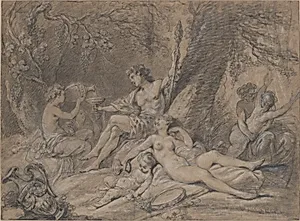
Bacchus and Ariadne
18th century
Medium
Black and white chalk
Dimensions
15 3/8 x 21 1/8 in. (39 x 53.7 cm)
Classification
Drawings
Department
Drawings and Prints
Museum
Metropolitan Museum of Art, New York, NY
Credit
Purchase, Guy Wildenstein Gift, 2008
Accession Number
2008.43
Rights
Public Domain
Tags
Art Historical Context
Jean-Hugues Taraval's *Bacchus and Ariadne (18th century) is a captivating black and white chalk drawing that brings the timeless myth of the Roman god of wine and his beloved Ariadne to life. Measuring 15⅜ × 21⅛ inches, this work from the Metropolitan Museum of Art's Drawings and Prints depicts the divine couple amid a leafy, tree-dotted landscape—a nod to the moment Bacchus discovers Ariadne abandoned on the island of Naxos Theseus, showering her with jewels and eternal love. Taraval, a French Rococo artist who later worked in Sweden, masterfully employs black and white chalk to create subtle tonal contrasts and fluid lines, techniques ideal for preparatory sketches or standalone studies in the 18th century. This medium allowed artists like him to explore light, shadow, and movement with exquisite delicacy, bridging the gap between painting and sculpture in the grand tradition of history painting. Acquired through the Guy Wildenstein Gift in 2008, the drawing exemplifies Rococo's playful elegance fused with classical mythology, offering visitors a window into Enlightenment-era fascination with ancient tales. Its intimate scale invites close contemplation of Taraval's nuanced handling of form and foliage, celebrating love's triumphant rescue amid nature's embrace.