
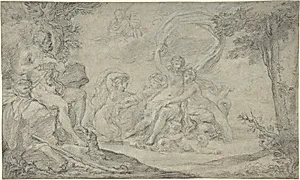
Polyphemus and Galatea
Medium
Black chalk, highlighted with white chalk, on blue paper faded to gray
Dimensions
8-5/16 x 13-7/8 in. (21.1 x 35.25 cm)
Classification
Drawings
Department
Drawings and Prints
Museum
Metropolitan Museum of Art, New York, NY
Credit
Bequest of Harry G. Sperling, 1971
Accession Number
1975.131.87
Rights
Public Domain
Tags
Art Historical Context
Behold *Polyphemus andatea*, a captivating 18th-century drawing to Giovanni Larciani, known as the "Master the Kress Landscapes." This intimate sheet (8-5/16 x 13-7/8 in.) plunges us into classical mythology, where the one-eyed giant Polyphemus gazes longingly at the sea nymphatea—figures immortalized in Ovid's tales of unrequited love and jealousy. boldly rendered male and female nudes showcase the artist's command of human anatomy, bridging landscape mastery with dynamic figural studies. Crafted in black chalk heightened with white on blue paper now faded to gray, the work employs a classic technique for dramatic effect. The tinted ground serves as a mid-tone, allowing black to sculpt shadows and white to illuminate highlights, evoking volume and ethereal light. This method, popular among draftsmen from the Renaissance onward, underscores the drawing's role as a virtuoso study, likely preparatory for larger compositions. Housed in the Metropolitan Museum of Art's Drawings and Prints department through the 1971 bequest of Harry G. Sperling, it reflects 18th-century fascination with antiquity amid the Rococo era's playful myth-making. A gem for lovers of technique and timeless stories, it invites you to trace the tension in Polyphemus's massive form against Galatea's graceful poise.
About the Artist
Giovanni Larciani ("Master of the Kress Landscapes") · 1700–1800
Giovanni di Lorenzo Larciani (1484–1527), a Florentine painter known initially as the "Master of the Kress Landscapes," emerged from obscurity in the mid-1990s through the scholarship of Louis Waldman, who linked him to documents including a 1521 contract for an altarpiece. Born and active in Florence until his death, Larciani specialized in religious scenes enriched by vivid, atmospheric landscap...