
Bacchus, Music, Amor
1575–1600
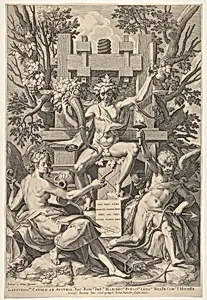
Medium
Engraving
Dimensions
sheet: 17 3/16 x 11 9/16 in. (43.7 x 29.3 cm)
Classification
Prints
Department
Drawings and Prints
Museum
Metropolitan Museum of Art, New York, NY
Credit
Bequest of Phyllis Massar, 2011
Accession Number
2012.136.907
Rights
Public Domain
Tags
Art Historical Context
This engraving, created between 1575 1600 by Flemish painter Joos van Winghe and master printmaker Johann Sadeler I, brings together the Roman god Bacchus, the figure of Music, and Cupid (Amor) in a lively allegorical composition. Bacchus appears with his traditional cornucopia of abundance, while musical instruments and the winged god of love complete the scene. The work celebrates the harmonious pleasures of wine, melody, and affection—popular themes in late Renaissance art that reflected humanist interests in the senses and classical mythology. As an engraving, this print played a vital role in spreading artistic ideas across Europe during the sixteenth and seventeenth centuries. Sadeler’s precise line work translated van Winghe’s design into a reproducible format, allowing collectors and scholars to enjoy the imagery beyond court or church settings. The medium’s fine detail captures textures of fabric, fruit, and instruments, demonstrating the technical sophistication of Northern European printmaking at the time. Housed in the Metropolitan Museum of Art’s Department of Drawings and Prints, the sheet invites viewers to consider how such images once decorated homes and inspired conversation about life’s delights. Its blend of mythological figures and everyday symbols continues to charm modern audiences with its timeless message of joy and creativity.
About the Artist
Johann Sadeler I|Joos van Winghe · 1550–1601
**Johann Sadeler I (also known as Jan or Johannes Sadeler), born in Brussels in 1550 and active until his death in Venice in 1600, stands as a pivotal figure in the Sadeler family, the most prolific dynasty of Flemish engravers and print publishers in Northern Europe during the late sixteenth and early seventeenth centuries.** As the eldest of three brothers—including Aegidius I and Raphael I—he ...