
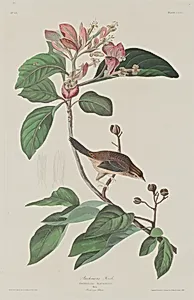
Bachmans Finch
Medium
hand-colored engraving and aquatint on Whatman wove paper
Dimensions
plate: 49.2 x 31 cm (19 3/8 x 12 3/16 in.) sheet: 99.2 x 67.6 cm (39 1/16 x 26 5/8 in.)
Classification
Department
CG-W
Museum
National Gallery of Art, Washington, D.C.
Credit
Gift of Mrs. Walter B. James
Accession Number
1945.8.165
Rights
Public Domain
Art Historical Context
**Bachman's Finch**, a stunning hand-colored engraving and aquatint created by Robert Havell after John James Audubon's original watercolor in 1833, captures the delicate beauty of this now-extinct North American bird. Part of Audubon's monumental *The Birds of America*—a landmark publication from 1827 to 1838—this print exemplifies the Romantic era's fusion of scientific precision and artistic splendor. Audubon, a pioneering naturalist and artist, depicted birds life-size against naturalistic settings, revolutionizing ornithological illustration and raising awareness of American wildlife during a time of rapid environmental change. Havell's masterful technique shines through the fine lines of engraving for feathers and branches, paired with aquatint's subtle tonal gradients for depth and realism. Printed on high-quality Whatman wove paper, the double-elephant folio sheet (nearly 40 x 27 inches) allowed for these grand, immersive scales, while hand-coloring by skilled artisans added vibrant hues that made each of the 435 plates unique. Housed in the National Gallery of Art as a gift from Mrs. Walter B. James, it highlights the era's printmaking innovation. This work not only documents Bachman's Finch—named for Audubon's collaborator, Rev. John Bachman—but also embodies cultural reverence for nature, influencing conservation and art alike. Visitors, imagine holding a piece of 19th-century exploration in your hands!
About the Artist
Robert Havell after John James Audubon
Robert Havell Jr., born on November 25, 1793, in Reading, Berkshire, England, was the son of renowned engraver and publisher Robert Havell Sr. and Lydia Miller Phillips. Growing up in a family of artists that included notable engravers and etchers, he trained under his father, mastering aquatint techniques early on. Though briefly estranged from the family business, Havell reconciled with his fath...