
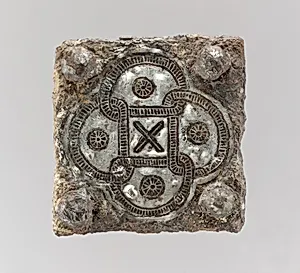
Back Plate from a Belt Buckle
Unknown Artist
7th century
Medium
Iron with silver inlay; one rivet a copper alloy (restoration?) …
Dimensions
Overall: 2 3/8 x 2 3/8 x 3/4 in. (6 x 6 x 1.9 cm)
Classification
Metalwork-Iron
Culture
Frankish
Department
Medieval Art
Museum
Metropolitan Museum of Art, New York, NY
Credit
Gift of J. Pierpont Morgan, 1917
Accession Number
17.191.321
Rights
Public Domain
Art Historical Context
This exquisite back plate from a Frankish belt buckle, dating to the 7 century, offers a glimpse into the daily life and craftsmanship of early medieval Europe. Crafted by an unknown artisan during the Merovingian period, when the Franks dominated much of what is now and Germany, this small iron piece (just 2 3/8 inches square) would have secured a belt, a practical accessory that also signaled status and identity. The artwork's medium—iron with intricate silver inlay and a copper-alloy rivet (possibly a later restoration)—highlights advanced metalworking techniques. The silver inlay, likely applied through niello or damascening methods, created contrasting patterns that elevated humble iron into something decorative and durable. Such metalwork was labor-intensive, reflecting skilled labor in Frankish workshops amid a time of cultural transition from late antiquity to the Middle Ages. Housed in the Metropolitan Museum of Art's Medieval Art Department as a gift from financier J. Pierpont Morgan in 1917, this buckle plate underscores the Franks' fusion of Germanic traditions with Roman influences. Belts like this adorned warriors and elites, symbolizing power and mobility in a warrior society. Its survival is a rare treasure, inviting us to imagine the hands that wore it over 1,300 years ago.