
Backplate of a Belt Buckle
Unknown Artist
6th–7th century
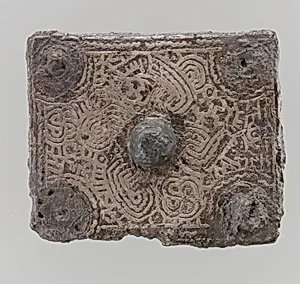
Medium
Iron, silver inlay, copper alloy
Dimensions
Overall: 2 11/16 x 2 5/16 x 11/16 in. (6.9 x 5.8 x 1.7 cm)
Classification
Metalwork-Iron
Culture
Frankish
Department
Medieval Art
Museum
Metropolitan Museum of Art, New York, NY
Credit
Gift of J. Pierpont Morgan, 1917
Accession Number
17.193.144
Rights
Public Domain
Art Historical Context
This exquisite backplate from a Frankish belt buckle dating to the 6–7th century, a glimpse into the daily life and craftsmanship of the Merovingian Franks, the Germanic tribe that dominated much of early medieval Europe, including modern-day France and Germany. During this turbulent post-Roman era, personal accessories like belt buckles were not just functional but symbols of status, often adorning warriors, elites, or merchants. Measuring a compact 2 11/16 x 2 5/16 x 11/16 inches, this small iron piece was likely part of a larger ensemble securing belts for clothing or weaponry. Crafted from iron with intricate silver inlay and copper alloy, the backplate showcases advanced metalworking techniques of the time. Artisans skillfully embedded silver into the iron surface—possibly using niello or similar inlay methods—to create contrasting designs that highlighted patterns or motifs, though wear has softened their details today. Such hybrid materials demonstrated the Franks' mastery in blending durability with decoration, bridging utilitarian iron tools and luxurious jewelry traditions from late antiquity. A generous gift to the Metropolitan Museum of Art from J. Pierpont Morgan in 1917, this artifact in the Medieval Art department underscores the cultural fusion of Germanic tribes with Roman influences, inviting us to appreciate the artistry behind everyday medieval splendor.