
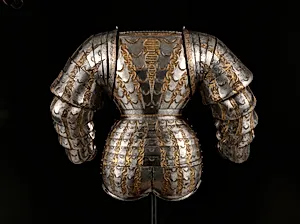
Backplate and Hoguine (Rump Defense) from a Costume Armor
ca. 1525
Medium
Steel, gold
Dimensions
H. 27 in. (68.6 cm); W. 18 in. (45.7 cm); Wt. 9 lb. 11.88 oz. (4419 g); backplate: H. 16 1/4 in. (41.3 cm); W. 14 5/8 in. (37.1 cm); D. 7 15/16 in. (20.2 cm); D. with shoulder straps extended 11 5/8 in. (29.5 cm); Wt. 4 lb. (14.6 oz. (2229 g); rump defense: H. 13 1/8 in. (33.4 cm); W. 16 3/4 in. (42.6 cm); D. 8 1/8 in. (20.7 cm); Wt. 4 lb. 13.25 oz. (2190 g)
Classification
Armor Parts
Culture
German, Augsburg
Department
Arms and Armor
Museum
Metropolitan Museum of Art, New York, NY
Credit
Gift of Bashford Dean, 1924
Accession Number
24.179
Rights
Public Domain
Art Historical Context
This striking backplate and hoguine, or rump defense, form the rear section of a costume armor made of steel and highlighted with gold. The polished plates display an elegant, symmetrical arrangement, with overlapping shoulder and arm defenses that curve outward. A central etched motif resembling a spine runs down the backplate, surrounded by flowing, flame-like patterns and scalloped borders in gold that catch the light against the silver-gray steel. The lower hoguine curves smoothly to protect the hips, its surface continuing the same intricate decoration. Created around 1525 by the Augsburg armorer Kolman Helmschmid, this ensemble reflects the refined tastes of the German Renaissance. Helmschmid’s workshop specialized in armor that combined protection with elaborate ornament, often produced for courtly display or tournament use rather than the battlefield. Such pieces were prized for their technical mastery and artistic detail, turning functional steel into wearable sculpture. Today in the Metropolitan Museum of Art, the armor invites visitors to appreciate how sixteenth-century armorers blended utility with beauty.
About the Artist
Kolman Helmschmid · 1471–1532
**Kolman Helmschmid: Master Armourer of the Renaissance** Kolman Helmschmid (1471–1532), born in Augsburg, Germany, emerged from one of Europe's most illustrious families of armourers, the Helmschmieds, whose name aptly means "helmet smith." The son of the renowned Lorenz Helmschmied (active 1467–1515), Kolman trained within the family workshop, taking control after his father's death in 1515 and...