
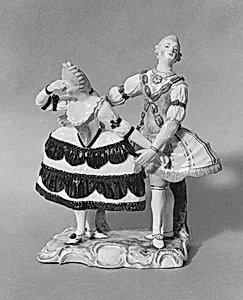
Ballet dancers
Medium
Hard-paste porcelain
Dimensions
Height: 6 3/8 in. (16.2 cm)
Classification
Ceramics-Porcelain
Culture
German, Ludwigsburg
Department
European Sculpture and Decorative Arts
Museum
Metropolitan Museum of Art, New York, NY
Credit
Gift of R. Thornton Wilson, in memory of Florence Ellsworth Wilson, 1950
Accession Number
50.211.224
Rights
Public Domain
Tags
Art Historical Context
This delicate hard-paste porcelain group, created around 1760–63 at the Ludwigsburg Porcelain Manufactory in Germany and modeled by Joseph Nees, captures the elegance of ballet dancers in mid-performance. Standing just over six inches tall, the small-scale sculpture reflects the Rococo era’s fascination with theatricality, grace, and courtly entertainment. German porcelain factories like Ludwigsburg, under ducal patronage, produced such figures as luxurious table decorations or cabinet displays for aristocratic collectors. Hard-paste porcelain, perfected in Europe during the early eighteenth century, allowed for fine detail and luminous surfaces that suited the lively poses and flowing costumes of dancers. Nees’s modeling brings a sense of movement to the medium, celebrating both the rising popularity of ballet as an art form and the technical achievements of German ceramic production. Today, the piece offers visitors a charming glimpse into eighteenth-century tastes for refined, miniature sculpture that blended artistry with social display.