
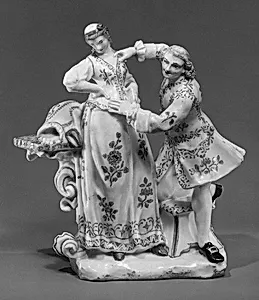
Woman and her tailor
Medium
Soft-paste porcelain
Dimensions
8 1/8 × 7 3/8 in. (20.6 × 18.7 cm)
Classification
Ceramics-Porcelain
Culture
Italian, Naples
Department
European Sculpture and Decorative Arts
Museum
Metropolitan Museum of Art, New York, NY
Credit
Gift of Irwin Untermyer, 1970
Accession Number
1970.277.25
Rights
Public Domain
Tags
Art Historical Context
**Woman and Her Tailor** (ca. 1744–46) is a delightful soft-paste porcelain figurine group crafted by Giuseppe Gricci the Royal Porcelain Manufactory of Capodimonte in, Italy. Measuring just over 8 inches tall, this intimate scene captures a woman being fitted by her tailor amid blooming flowers, blending everyday domesticity with playful elegance. Gricci, the factory's chief sculptor, was renowned for his lively modeling of such figural groups, which brought Rococo whimsy to porcelain. Founded in 1743 by Charles VII of Naples (later Charles III of Spain), Capodimonte quickly rivaled Europe's finest porcelain centers like Meissen and Sèvres. Its soft-paste formula—made from a glassy frit mixed with clay and fired at lower temperatures—allowed for exceptional detail in delicate features, flowing drapery, and naturalistic poses. This technique produced a creamy, translucent body prized for its sculptural possibilities, though pieces were fragile and often marked with the distinctive blue crown over "C" for Carlo. Today, housed in The Metropolitan Museum of Art's European Sculpture and Decorative Arts collection, *Woman and Her Tailor* exemplifies 18th-century Neapolitan porcelain's cultural vibrancy. It reflects the era's fascination with commedia dell'arte-inspired vignettes and floral motifs, offering visitors a glimpse into the refined tastes of Bourbon royalty and the artistry that made Capodimonte a porcelain powerhouse.
About the Artist
Giuseppe Gricci|Capodimonte Porcelain Manufactory (Italian|Italian) · 1695 |1740 –1775 |1759
Italian, ca. 1700–1770|Italian, 1740/43–1759