
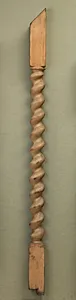
Baluster
Unknown Artist
early 18th century
Medium
Deal
Dimensions
Height: 32 1/2 in. (82.6 cm)
Classification
Woodwork
Culture
British
Department
European Sculpture and Decorative Arts
Museum
Metropolitan Museum of Art, New York, NY
Credit
Rogers Fund, 1932
Accession Number
32.106.46
Rights
Public Domain
Art Historical Context
This elegant baluster, crafted in the early 18th century by an unknown British artisan, exemplifies the refined woodwork of Georgian-era Britain. Standing at 32½ inches tall and made from deal—a softwood like pine or fir prized for its workability—this turned column was likely part of a grand staircase orustrade in a stately home. Acquired through the Rogers Fund in 1932, it now graces the Metropolitan Museum of Art's European Sculpture and Decorative Arts collection. Balusters like this were essential architectural elements, supporting handrails while adding rhythmic ornamentation to interiors. During the early 1700s, as Queen Anne and early Georgian styles evolved, British craftsmen mastered lathe-turning techniques to create balusters with swelling profiles, subtle fluting, and graceful curves. Deal's affordability made it ideal for such domestic splendor, blending functionality with subtle elegance amid the period's growing taste for symmetry and classical restraint. Though unattributed, this piece highlights the anonymous skill of woodworkers whose innovations shaped everyday luxury, offering a tangible glimpse into Britain's architectural heritage. Visitors can appreciate how such modest objects elevated ordinary spaces into statements of status and sophistication.