
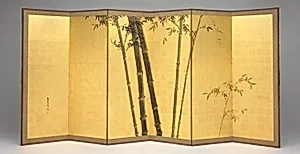
Bamboo
Early 19th century
Medium
Pair of six-panel screens; ink and gold leaf on paper
Dimensions
178 × 376 cm (70 × 148 in.)
Classification
screen
Department
Arts of Asia
Museum
Art Institute of Chicago
Accession Number
92960
Rights
Public Domain
Art Historical Context
Kishi Ganku's *Bamboo*, a pair of six-panel folding screens from the early 19th century, captures the timeless elegance of this resilient plant in ink on gold-leafed paper. Measuring an impressive 178 × 376 cm, these screens were designed as luxurious room dividers (byōbu) in Japanese homes or tea houses, transforming interiors into immersive natural scenes. The shimmering gold background evokes misty dawn light or rippling water, a technique that heightens the bamboo's graceful stalks and leaves, swaying with implied wind. Ganku (1749–1820), a master of the literati (nanga) style blending Chinese scholarly traditions with Japanese sensibility, elevated bamboo as a symbol of integrity, flexibility, and purity in East Asian culture—qualities revered in Confucian and Zen ideals. His bold, expressive ink washes and minimalist composition showcase virtuosic brushwork, where each stroke conveys vitality and rhythm. This work exemplifies late Edo-period painting, bridging professional studio art with poetic introspection. Housed in the Art Institute of Chicago's Arts of Asia department, *Bamboo* invites visitors to contemplate nature's quiet strength, much like the plant itself bending but never breaking in the storm. A testament to Ganku's legacy, it remains a highlight of Japanese screen art's splendor.