
Bamboo and Tiger
c. 1725
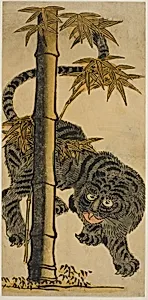
Medium
Hand-colored woodblock print; hosoban, urishi-e
Dimensions
30.2 × 14.7 cm (11 7/8 × 5 3/4 in.)
Classification
woodblock print
Department
Arts of Asia
Museum
Art Institute of Chicago
Accession Number
19806
Rights
Public Domain
Art Historical Context
**Bamboo and** is a captivating hand-colored woodblock print byimura Shigenaga, around 1725 during Japan's vibrant Edo period. Shigenaga, a pioneering ukiyo-e artist by masters like Okumura Masobu, specialized in early color printing techniques. This compact *hosoban* format—measuring just 30.2 × 14.7 cm—makes it a slender, intimate artwork, ideal for personal collection or album mounting, unlike larger theatrical prints. The *urushi-e* method, meaning "lacquer picture," shines here: colors were hand-applied with glossy lacquer or glue for a luminous effect, bridging traditional monochromatic woodblocks and the later full-color *nishiki-e*. Depicting bamboo stalks and a fierce tiger, it evokes nature's harmony and power—bamboo symbolizing resilience in Japanese culture, the tiger embodying strength and protection. Such motifs blended poetry with everyday artistry in ukiyo-e's "floating world." Housed in the Art Institute of Chicago's Arts of Asia department, this print highlights ukiyo-e's evolution, showcasing Shigenaga's innovative role in democratizing art through affordable, reproducible beauty for urban audiences. A window into 18th-century Japan's aesthetic refinement! (198 words)
About the Artist
Nishimura Shigenaga · 1690–1758
Nishimura Shigenaga (c. 1697–1756) was a pioneering Japanese ukiyo-e printmaker born in Edo (modern-day Tokyo), where he initially worked as a landlord in the Tōriabura-chō district before relocating to Kanda-Sakumachō to operate a bookshop. Self-taught with no known formal teacher, he immersed himself in art around 1719, drawing early inspiration from the Torii school's yakusha-e (actor portraits...