
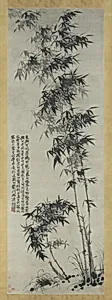
清 石濤 (朱若極) 風雨竹圖 軸|Bamboo in wind and rain
ca. 1694
Medium
Hanging scroll; ink on paper
Dimensions
Image: 87 3/4 in. × 30 in. (222.9 × 76.2 cm) Overall with mounting: 11 ft. 1/4 in. × 37 3/8 in. (335.9 × 94.9 cm) Overall with knobs: 11 ft. 1/4 in. × 41 in. (335.9 × 104.1 cm)
Classification
Paintings
Culture & Period
China · Qing dynasty (1644–1911)
Department
Asian Art
Museum
Metropolitan Museum of Art, New York, NY
Credit
Edward Elliott Family Collection, Gift of Douglas Dillon, 1984
Accession Number
1984.475.2
Rights
Public Domain
Tags
Art Historical Context
Shitao (Zhu Ruoji), a leading individualist painter of the early Qing dynasty, created this expressive hanging scroll around 1694. A former Ming imperial descendant who became a Buddhist monk, Shitao rejected rigid academic traditions in favor of spontaneous, personal expression. His "Bamboo in Wind and Rain" captures the plant’s slender stalks bending under nature’s force, using fluid ink washes and dynamic brushstrokes on paper to convey motion, texture, and atmosphere. In Chinese culture, bamboo symbolizes resilience, integrity, and scholarly virtue—qualities that resonated deeply during the turbulent transition from Ming to Qing rule. The large-scale format, typical of hanging scrolls meant for contemplative viewing in scholars’ studios, invites viewers to appreciate both the subject’s endurance and Shitao’s innovative technique. The work exemplifies his lifelong exploration of nature as a mirror for human experience. Housed in the Metropolitan Museum of Art’s Asian Art collection, this piece highlights the enduring vitality of literati painting traditions even as China entered a new political era.