
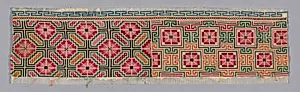
Band
Qing dynasty (1644–1911), 1875/1900
Medium
Forty-four pairs and eight odd pieces of embroidered sleeve, ankle bands, etc. on gauze.
Dimensions
12 × 38.9 cm (4 3/4 × 15 1/4 in.)
Classification
costume - embroidery
Department
Textiles
Museum
Art Institute of Chicago
Accession Number
156162
Rights
Public Domain
Art Historical Context
### Qing Dynasty Embroidered Bands This delicate artwork, simply titled *Band*, hails from China's Qing dynasty (1644–1911), dated to around 1875–1900, and was crafted by Han-Chinese artisans. Comprising forty-four pairs and eight individual pieces of embroidered sleeve bands, ankle bands, and similar elements mounted on sheer gauze, it measures a compact 12 × 38.9 cm (4 3/4 × 15 1/4 in.). Housed in the Art Institute of Chicago's Textiles Department, this ensemble exemplifies the exquisite embroidery traditions of late imperial China, where such bands adorned the edges of robes, sleeves, and hems in everyday and ceremonial garments. In the Qing era, under Manchu rule but deeply influenced by Han-Chinese culture, textiles like these were essential to personal adornment, signaling status, ethnicity, and refinement. Han-Chinese embroidery often featured intricate stitches on lightweight gauze—a fine, translucent silk fabric ideal for summer wear or layered clothing—highlighting the wearer's elegance through subtle sheen and detail. The abundance of matched pairs suggests these were either from a single lavish garment or a collector's assortment, showcasing the period's mastery of repetitive, labor-intensive needlework. Artistically, this piece underscores embroidery's role as a democratic art form in China, accessible yet virtuoso, blending functionality with beauty. Visitors will appreciate how these tiny bands capture the Qing's opulent textile heritage, where every thread wove stories of cultural continuity and craftsmanship.
About the Artist
Han-Chinese
**Han-Chinese** was the collective attribution given to anonymous artisans of Han Chinese descent who crafted intricate embroidered textiles during the Qing dynasty (1644–1911). These makers, active primarily in the late 18th to early 20th centuries, specialized in luxurious garments and furnishings that showcased the pinnacle of Han Chinese needlework traditions. Their early lives and individual ...