
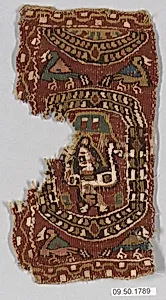
Band Fragment
Unknown Artist
6th–7th century
Medium
Linen, wool; tapestry weave
Dimensions
H. 7 in. (17.8 cm) W. 3 5/8 in. (9.2 cm)
Classification
Textiles
Department
Islamic Art
Museum
Metropolitan Museum of Art, New York, NY
Credit
Rogers Fund, 1909
Accession Number
09.50.1789
Rights
Public Domain
Tags
Art Historical Context
This delicate **Band Fragment**, dating to the 6th–7th century, offers a glimpse into the masterful textile traditions of the early Islamic world. Crafted from linen and wool using tapestry weave—a technique where colored weft threads are woven into a linen warp to create vibrant, pictorial patterns—this small strip (just 7 inches high and 3⅝ inches wide) likely adorned clothing, furnishings, or ceremonial objects. Its presence in the Metropolitan Museum of Art's Islamic Art department highlights its role as a preserved relic from a time of cultural flourishing in regions like Egypt or the Near East. The artwork's bird motifs, a recurring tag in its description, reflect motifs common in ancient textiles, symbolizing vitality and the natural world. Tapestry weave was prized for its durability and ability to produce intricate designs without painting or dyeing the entire fabric, making it ideal for both everyday and elite use. Such fragments are rare survivors, as organic materials rarely endure millennia. As part of the Rogers Fund acquisition of 1909, this piece invites us to appreciate the anonymous artisans whose skill bridged late antiquity and the Islamic Golden Age, weaving stories of beauty into the fabric of history.