
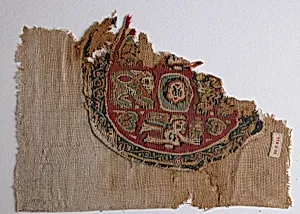
Fragment of Roundel
Unknown Artist
7th–8th century
Medium
Linen, wool
Dimensions
Max. H. 6 3/8 in. (16.2 cm) Max. W. 9 in. (22.9 cm)
Classification
Textiles
Department
Islamic Art
Museum
Metropolitan Museum of Art, New York, NY
Credit
Gift of George F. Baker, 1890
Accession Number
90.5.835
Rights
Public Domain
Art Historical Context
This delicate *Fragment of Roundel*, by an unknown artist in the th–8th century offers a glimpse into the rich textile traditions of early Islamic art. Woven from linen and wool, this small piece—measuring just 6 3/8 inches high and 9 inches wide—survives as a segment of a larger roundel, a circular motif popular in the period. Housed in the Metropolitan Museum Art's Islamic Art Department, it was generously gifted by George F. Baker in 1890. Textiles like this flourished in regions such as Egypt under Umayyad or early Abbasid rule, where skilled weavers blended local Coptic techniques with influences from Byzantine and Sasanian designs. The use of linen for the ground and wool for patterns highlights advanced loom work, creating durable yet ornate fabrics for garments, furnishings, or ceremonial use. Roundels often framed animals, plants, or geometric forms, symbolizing abundance and continuity in a time of cultural exchange along trade routes. Though fragmented, this artifact underscores the artistry of early Islamic craftsmen, who preserved pre-Islamic motifs amid the rise of a new aesthetic. It invites us to appreciate how everyday materials wove stories of innovation and heritage across centuries.