
Bandbox
1935/1942
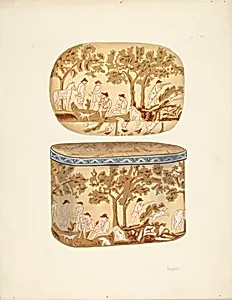
Medium
watercolor, graphite, and gouache on paperboard
Dimensions
overall: 29.2 x 22.9 cm (11 1/2 x 9 in.) Original IAD Object: 19 3/4" deep
Classification
Index of American Design
Department
CG-W
Museum
National Gallery of Art, Washington, D.C.
Credit
Index of American Design
Accession Number
1943.8.17338
Rights
Public Domain
Art Historical Context
**Bandbox** by Lee Hager (1935/1942) is a meticulous rendering of a classic American bandbox—a lightweight, portable container once essential for storing collars, hats, or linens. Created using watercolor, graphite, and gouache on paperboard (29.2 x 22.9 cm), this piece captures the object's intricate wallpaper-like patterns, vibrant colors, sturdy construction with remarkable precision. Hager's skilled layering of media brings out the tactile qualities of the original, evoking the everyday elegance of 19th-century domestic life. This artwork is part of the *Index of American Design*, a groundbreaking WPA Federal Art Project from the Great Depression era (1935–1942). Artists like Hager documented thousands of folk art objects across the U.S., preserving cultural heritage through detailed, full-color illustrations when originals were fragile or scattered. Housed in the National Gallery of Art's CG-W department, it reflects New Deal efforts to celebrate American craftsmanship amid economic hardship. Bandboxes symbolize resourcefulness in early American homes, often handmade by women with decoupage techniques using printed papers. Hager's work not only highlights this folk tradition but also showcases the Index's artistic innovation—blending technical accuracy with aesthetic beauty to inspire appreciation for our shared design legacy.
About the Artist
Lee Hager · 1909–1960
**Lee Hager (c. 1909–1960)** was an American artist and designer known for his detailed watercolor and gouache renderings of American decorative arts as well as later abstract compositions. Born in New York around 1909, he spent much of his career in the city, where he died in 1960 at age 51 after a long illness. Early biographical details remain limited, with no documented information on formal ...