
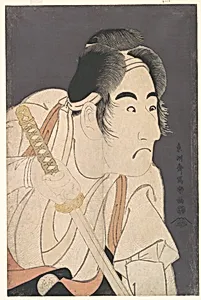
東洲斎写楽画 二世坂東三津五郎の石井源蔵 『花菖蒲文禄曽我』|Bandō Mitsugorō II as Ishii Genzō in the Play "Hana-ayame Bunroku Soga"
ca. 1794
Medium
Woodblock print; ink, color, white mica on paper
Dimensions
H. 15 in. (38.1 cm); W. 9 15/16 in. (25.2 cm)
Classification
Prints
Culture & Period
Japan · Edo period (1615–1868)
Department
Asian Art
Museum
Metropolitan Museum of Art, New York, NY
Credit
Harris Brisbane Dick Fund and Rogers Fund, 1949
Accession Number
JP3113
Rights
Public Domain
Tags
Art Historical Context
In the vibrant world of Edo-period Japan (1615–1868), Tōshūsai Sharaku captured the dramatic essence of kabuki theater with this striking woodblock print from around 1794. The artwork portrays renowned actor Bandō Mitsugorō II in the role of Ishii Genzō from the play *Hana-ayame Bunroku Soga* (Flower Iris Bunroku Soga). Genzō, a fierce gripping a sword, embodies the theatrical intensity of kabuki, where performers like Mitsugorō brought historical tales to life on stage, blending revenge, loyalty, and spectacle for enthusiastic urban audiences in Edo (modern Tokyo). Sharaku, a enigmatic artist active for just two brief years, revolutionized ukiyo-e prints—Japan's popular "pictures of the floating world"—with his bold, unflinching portraits of actors. Unlike the idealized beauty of contemporaries, Sharaku's style is psychologically penetrating, highlighting exaggerated expressions, muscular forms, and dynamic poses that reveal the performer's raw emotion and character. Here, the close-up view draws viewers into the actor's world, making theater stars accessible icons. Crafted as a polychrome woodblock print with ink, vibrant colors, and shimmering white mica on paper (measuring 15 x 9 15/16 inches), the medium allowed mass production and affordability, democratizing art. The mica adds a luxurious, stage-like glow, evoking lantern light on the kabuki stage. Acquired by The Metropolitan Museum of Art in 1949, this piece exemplifies how prints preserved and popularized Japan's theatrical golden age.
About the Artist
Tōshūsai Sharaku · 1794–1795
Tōshūsai Sharaku stands as one of the most enigmatic figures in Japanese art history, a ukiyo-e printmaker whose brilliant career blazed for just ten months from the summer of 1794 to early spring 1795. Active exclusively in Edo (modern Tokyo), he produced approximately 150 woodblock prints and sketches, primarily yakusha-e—intimate portraits of kabuki actors captured mid-performance. Published by...