
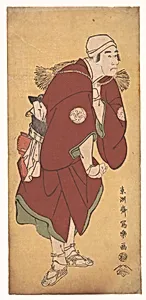
Bandō Mitsugorō II as the Farmer Asakusa no Jirōsaku
1794–95
Medium
Woodblock print; ink and color on paper
Dimensions
Image: 12 3/4 × 5 15/16 in. (32.4 × 15.1 cm) Mat: 22 3/4 × 15 1/2 in. (57.8 × 39.4 cm)
Classification
Prints
Culture & Period
Japan · Edo period (1615–1868)
Department
Asian Art
Museum
Metropolitan Museum of Art, New York, NY
Credit
Harris Brisbane Dick Fund and Rogers Fund, 1949
Accession Number
JP3124
Rights
Public Domain
Tags
Art Historical Context
This striking woodblock print by Tōshūsai Sharaku captures the celebrated kabuki actor Bandō Mitsugorō II in the role of the farmer Asakusa no Jirōsaku. Created during Sharaku’s remarkably brief but intense period of activity between 1794 and 1795, the work belongs to the vibrant tradition of ukiyo-e actor portraits that flourished in Japan’s Edo period. Sharaku specialized in revealing the inner intensity of performers, often through bold facial expressions and dramatic poses that brought the excitement of the kabuki stage to life on paper. As a woodblock print in ink and color, the piece exemplifies the technical sophistication of Japanese printmaking, where multiple carved blocks allowed for precise registration of line and hue. Such prints were affordable souvenirs for theatergoers and helped turn actors into popular celebrities. Sharaku’s distinctive approach—marked by psychological depth and dynamic composition—set his roughly 140 surviving works apart from more conventional portrayals, making them prized examples of late-eighteenth-century Japanese art. Today this impression in the Metropolitan Museum’s collection offers visitors a vivid window into Edo-period entertainment culture and the fleeting brilliance of one of ukiyo-e’s most enigmatic masters.
About the Artist
Tōshūsai Sharaku · 1794–1795
Tōshūsai Sharaku stands as one of the most enigmatic figures in Japanese art history, a ukiyo-e printmaker whose brilliant career blazed for just ten months from the summer of 1794 to early spring 1795. Active exclusively in Edo (modern Tokyo), he produced approximately 150 woodblock prints and sketches, primarily yakusha-e—intimate portraits of kabuki actors captured mid-performance. Published by...