
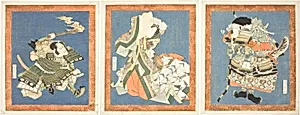
Bando Mitsugoro III as Minamoto no Yorimasa (right), Segawa Kikunojo V as Ayame no Mae (center), and Ichikawa Danjuro VII as I no Hayata (left)
Medium
Color woodblock prints; shikishiban triptych, surimono
Dimensions
20.8 × 18.1 cm (right), 21.0 × 18.2 cm (center), 20.8 × 18.0 cm (left)
Classification
woodblock print
Department
Arts of Asia
Museum
Art Institute of Chicago
Accession Number
182348
Rights
Public Domain
Art Historical Context
This vibrant color woodblock print triptych by Utagawa Kunisada I (also known as Toyokuni III) captures three celebrated kabuki actors in character around 1820. On the right, Bandō Mitsugorō III portrays the noble Minamoto no Yorimasa; in the center, Segawa Kikunojō V appears as Ayame no Mae; and on the left, Ichikawa Danjūrō VII embodies I no Hayata. Created as a shikishiban surimono—a privately commissioned format often exchanged among poetry circles—the work highlights the dynamic world of Edo-period theater and the intense popularity of its stars. Kunisada, one of the leading ukiyo-e masters of his time, specialized in yakusha-e (actor prints) that conveyed both likeness and dramatic presence. The square shikishiban format and luxurious surimono techniques, including refined printing and possible metallic or embossed details, underscore the print’s status as a refined keepsake rather than a mass-produced sheet. Together, the three panels form a lively stage-like composition that preserves a fleeting theatrical moment for posterity. Housed in the Art Institute of Chicago’s Arts of Asia collection, this triptych offers modern viewers an intimate glimpse into Japan’s rich kabuki tradition and the artistic brilliance of 19th-century woodblock printmaking.
About the Artist
Utagawa Kunisada I (Toyokuni III) · 1786–1864
Utagawa Kunisada I, also known as Toyokuni III (1786–1865), was born Sumida Shōgorō in the Honjo district of Edo (modern Tokyo) into a family that operated a hereditary ferry-boat service, providing stability after his father's early death. Displaying prodigious talent in drawing from childhood, he became an apprentice to the master Utagawa Toyokuni I around 1801 at age fifteen, entering the prest...