
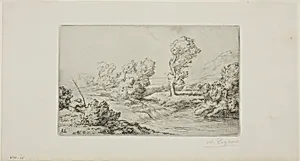
Banks of the Marne
c. 1883
Medium
Etching, drypoint and plate tone on light-green laid paper
Dimensions
Plate: 12 × 17.5 cm (4 3/4 × 6 15/16 in.); Sheet: 15.3 × 28.4 cm (6 1/16 × 11 3/16 in.)
Classification
etching
Department
Prints and Drawings
Museum
Art Institute of Chicago
Accession Number
51289
Rights
Public Domain
Art Historical Context
Alphonse Legros, a French-born artist who became a pivotal figure in British art after settling in London in 1863, captures the serene beauty of the Marne River's banks in this etching from around 1883. The Marne, winding through the French countryside near Paris, inspired many 19th-century artists seeking respite from urban life. Legros, renowned for realist landscapes and portraits, blends meticulous observation with a poetic atmosphere, reflecting his role in the etching revival that bridged Realism and emerging Impressionist influences. Printed on light-green laid paper—a traditional support prized for its texture and absorbency—this work showcases Legros's mastery of mixed intaglio techniques. Etching provides crisp lines for defining the river's edge and foliage, while drypoint adds velvety burrs for soft textures like misty water and shadowed banks. Plate tone, achieved by selectively wiping ink from the plate, infuses the scene with subtle, luminous depth, evoking the hazy light of a quiet afternoon. At just 12 × 17.5 cm, its intimate scale invites close viewing, much like a private sketchbook page. Housed in the Art Institute of Chicago's Prints and Drawings department, *Banks of the Marne* exemplifies Legros's influence as a teacher at London's Slade School, where he championed printmaking's expressive potential. This piece not only documents a vanishing rural idyll amid France's industrialization but also highlights etching's democratic appeal, making fine art accessible beyond oil paintings.
About the Artist
Alphonse Legros · 1837–1911
Alphonse Legros (1837–1911) was born in Dijon, France, and trained in Paris at the drawing school of Horace Lecoq de Boisbaudran, whose unconventional teaching method — which emphasised memory drawing and acute observation over academic convention — would leave a lasting mark on Legros's practice. At Lecoq's school he formed friendships with Jules Dalou and Auguste Rodin that endured throughout hi...