
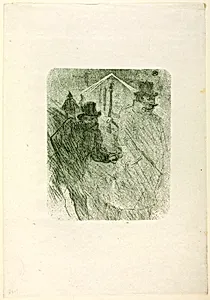
Baron Moïse Begging, from Au Pied du Sinaï
1897, published 1898
Medium
Color lithograph on ivory wove paper
Dimensions
Image: 17.5 × 14.4 cm (6 15/16 × 5 11/16 in.); Sheet: 33.9 × 23.6 cm (13 3/8 × 9 5/16 in.)
Classification
lithograph
Department
Prints and Drawings
Museum
Art Institute of Chicago
Accession Number
134560
Rights
Public Domain
Art Historical Context
Henri de Toulouse-Lautrec was a French Post-Impressionist artist celebrated for his vivid, observational depictions of modern Parisian life. Created in 1897 and published the next year, this color lithograph from *Au Pied du Sinaï* showcases his mastery of printmaking. Lautrec used the medium to produce lively, accessible images that captured social scenes with economy, wit, and a keen eye for human character and gesture. Printed on ivory wove paper, the small image (just under 7 by 6 inches) relies on layered colors achieved through multiple lithographic stones. This technique, which Lautrec helped popularize, allowed rich yet flattened effects, bold outlines, and a sense of immediacy. His style—influenced by Japanese prints and focused on simplified forms—brings the figure of Baron Moïse to life even in this intimate scale. As part of the Art Institute of Chicago’s prints and drawings collection, the work highlights Lautrec’s contributions beyond his famous posters, revealing his skill in book illustration and graphic arts. It offers visitors a window into how he infused everyday or character-driven subjects with artistic energy and humanity.
About the Artist
Henri de Toulouse-Lautrec · 1864–1901
Henri Marie Raymond de Toulouse-Lautrec-Montfa (1864-1901) was a French Post-Impressionist painter, printmaker, and illustrator whose innovative poster designs revolutionized graphic art and advertising in late 19th-century Paris. Born into an aristocratic family at Albi in southern France, Toulouse-Lautrec's privileged lineage traced back to the Counts of Toulouse and extended uninterrupted to th...