
Barrel Piano
ca. 1860
Medium
Wood, various materials
Dimensions
Total H. 92.7 cm (36 1/2 in.), W. 43.5 cm (17 1/8 in.)
Classification
Chordophone-Zither-struck-piano
Culture
American
Department
Musical Instruments
Museum
Metropolitan Museum of Art, New York, NY
Credit
The Crosby Brown Collection of Musical Instruments, 1889
Accession Number
89.4.2048
Rights
Public Domain
Tags
Art Historical Context
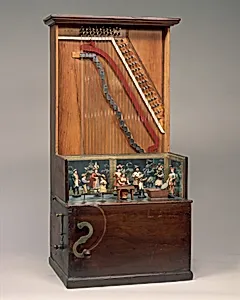
This charming barrel piano, around 1860 by maker George Hicks, a fascinating blend of craftsmanship mechanical ingenuity. Standing over three feet tall, instrument features a wooden case housing a struck-zither mechanism— a compact piano whose hammers strings when activated by pins on a rotating barrel. devices allowed users to enjoy popular tunes without needing formal musical training, reflecting the era’s growing interest accessible home entertainment. Historically, barrel pianos emerged in the mid-nineteenth century as street and domestic instruments, bridging traditional music-making with early automation. This example, part of the Metropolitan Museum’s Crosby Brown Collection since 1889, highlights the American adaptation of European mechanical traditions. Its modest scale and simple wooden construction made it both portable and affordable, appealing to a broad audience across social classes. Beyond its musical function, the piano’s decorative elements and tags referencing men and women suggest it may have served as a conversation piece in parlors or public spaces, evoking scenes of communal leisure. Today, it offers visitors a tangible connection to the sounds and social life of Victorian-era America.