
Chamber Organ
18th century
Medium
Wood, various materials
Dimensions
H.: 217 cm (85-1/2 in.) Top section: 95 cm w x 46 cm d x 134 cm high with crown Bottom section (location 8B): 104 cm w x 49 cm d x 86 cm H.
Classification
Aerophone-Organ|Paintings
Culture
German
Department
Musical Instruments
Museum
Metropolitan Museum of Art, New York, NY
Credit
The Crosby Brown Collection of Musical Instruments, 1889
Accession Number
89.4.3516
Rights
Public Domain
Art Historical Context
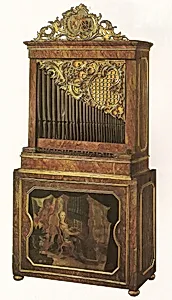
This elegant chamber organ, crafted in 18th-century Germany, exemplifies the refined musical culture of the Baroque era. Designed for intimate domestic settings rather than grand cathedrals, such instruments allowed wealthy patrons to enjoy keyboard music in the comfort of their homes. Its dual classification as both an aerophone-organ and paintings highlights the seamless blend of functional craftsmanship and decorative artistry typical of the period, with the maker possibly linked to Franz Caspar Hofer or remaining unknown. Constructed primarily of wood with various materials, the organ stands over two meters tall and features distinct upper and lower sections that house its pipes and mechanism. The rich woodwork and any painted embellishments would have contributed to its visual appeal, transforming a musical device into a sculptural centerpiece. As part of the Metropolitan Museum’s Crosby Brown Collection, acquired in 1889, it preserves a tangible link to the sounds and aesthetics of Enlightenment-era Europe. Visitors can appreciate how this piece reflects broader cultural values, where music, art, and technology converged in everyday life. Its presence in the museum invites us to imagine the delicate melodies that once filled private chambers, underscoring the organ’s enduring role as both instrument and artwork.
About the Artist
Franz Casppar Hofer|Unknown (German| ) · 1758 | –1758 |
German, active 1758|