
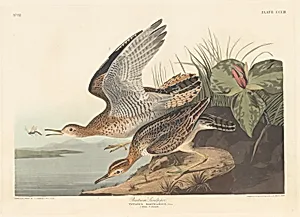
Bartram Sandpiper
Medium
hand-colored engraving and aquatint on Whatman wove paper
Classification
Department
CG-W
Museum
National Gallery of Art, Washington, D.C.
Credit
Gift of Mrs. Walter B. James
Accession Number
1945.8.303
Rights
Public Domain
Art Historical Context
**Bartram Sandpiper**1836) is a stunning plate from John James Audubon's groundbreaking *Birds of America*, most ambitious ornithological project of the 19th century Created after Audubon's original watercolor by master engraver Robert Havell., this print captures the Bartram Sandpiper—now known as the Upland Sandpiper—in a dynamic, life-sized pose amid its natural habitat. Audubon, a self-taught artist and naturalist, revolutionized bird illustration by depicting species in realistic, animated settings rather than stiff, taxonomic poses, blending scientific precision with artistic flair during the Romantic era's fascination with nature. The medium—hand-colored engraving and aquatint on Whatman wove paper—highlights 19th-century printmaking excellence. Aquatint allowed for subtle tonal gradations mimicking feathers and landscapes, while skilled colorists applied vibrant hues by hand, ensuring each of the folio's 435 plates was a unique work of art. Printed on durable Whatman paper, these double-elephant folio sheets (about 26 x 39 inches) were luxury items subscribed to by Europe's elite, making American wildlife accessible worldwide. Housed in the National Gallery of Art as a gift from Mrs. Walter B. James, this print exemplifies how Audubon's vision elevated natural history into high art, influencing conservation and field illustration for generations. Visitors, imagine the thrill of early subscribers unrolling these majestic birds!
About the Artist
Robert Havell after John James Audubon
Robert Havell Jr., born on November 25, 1793, in Reading, Berkshire, England, was the son of renowned engraver and publisher Robert Havell Sr. and Lydia Miller Phillips. Growing up in a family of artists that included notable engravers and etchers, he trained under his father, mastering aquatint techniques early on. Though briefly estranged from the family business, Havell reconciled with his fath...