
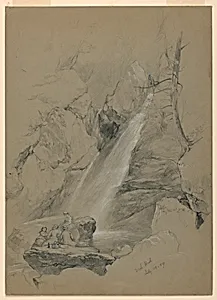
Bash-Bish Falls, South Egremont, Massachusetts
July 18, 1859
Medium
landscapes
Classification
landscapes
Department
Smithsonian Collection
Museum
Smithsonian American Art Museum
Credit
Bequest of Erskine Hewitt
Accession Number
1942-50-202
Rights
Public Domain
About this artwork
Research in Progress
Art Historical Context
Daniel Huntington's *Bash-Bish Falls, South Egremont, Massachusetts dated July 18, 1859, captures the dramatic beauty of one of New England's most striking natural landmarks. This landscape painting by the American artist (1816–1906) depicts Bash-Bish Falls, Massachusetts' tallest single-drop waterfall, located near the New York border in the Berkshires. The precise dating suggests Huntington may have sketched or painted it on site during a summer visit, immersing himself in the region's lush wilderness. In the mid-19th century, American artists increasingly turned to landscapes to celebrate the young nation's untamed scenery, evoking Romantic awe at nature's power. Huntington, known for his contributions to this tradition, rendered such scenes with a keen eye for light, water, and foliage, highlighting the falls' misty cascade and surrounding greenery. Though research on this work is ongoing, it exemplifies the era's fascination with accessible natural wonders, just as railroads opened remote spots like South Egremont to urban visitors. Now housed in the Smithsonian American Art Museum's Smithsonian Collection through the bequest of Erskine Hewitt, *Bash-Bish Falls* invites us to pause and appreciate America's pastoral heritage—a timeless reminder of the sublime in everyday exploration.