
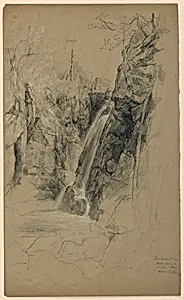
A Waterfall
Classification
landscapes
Department
Smithsonian Collection
Museum
Smithsonian American Art Museum
Credit
Bequest of Erskine Hewitt
Accession Number
1942-50-215
Rights
Public Domain
About this artwork
Research in Progress
Art Historical Context
**A Waterfall** by Daniel Huntington (1816–1906) the majestic beauty of nature, a hallmark of mid-19th-century American painting. Created between 1855 and 1865, this work reflects Huntington's early career as a versatile artist trained at the National Academy of Design. Though best known for portraits and historical scenes, Huntington contributed to the romantic tradition of depicting America's wild frontiers, evoking awe and the sublime power of the natural world. Painted during a transformative era in American art, when the Hudson River School celebrated the nation's expanding wilderness amid rapid industrialization, *A Waterfall* embodies the era's reverence for untamed landscapes. Huntington's contemporaries, like Thomas Cole and Frederic Edwin Church, popularized such scenes, portraying waterfalls as symbols of divine energy and national identity. This piece, classified as a landscape, invites viewers to ponder humanity's place amid nature's grandeur. Now housed in the Smithsonian American Art Museum as part of the Smithsonian Collection, it entered through the generous bequest of Erskine Hewitt, a noted collector. With ongoing research enhancing our understanding, *A Waterfall* remains a poignant reminder of 19th-century America's artistic embrace of its dramatic terrain. (198 words)