
Basin (Jatte ovale de pot à l'eau)
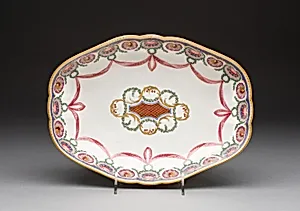
Medium
Enameled and gilded soft-paste porcelain
Dimensions
5.4 × 28.9 × 21.3 cm (2 1/8 × 11 3/8 × 8 3/8 in.)
Classification
ceramics
Department
Applied Arts of Europe
Museum
Art Institute of Chicago
Accession Number
222864
Rights
Public Domain
Art Historical Context
Created in 1763 at the Manufacture nationale de Sèvres, France’s prestigious royal porcelain factory, this elegant oval basin exemplifies the refined luxury of mid-eighteenth-century European ceramics. Produced during the reign of Louis XV, Sèvres wares were prized by the French court and aristocracy for their technical sophistication and delicate beauty. The piece, intended as part of a water jug set (pot à l’eau), reflects the period’s taste for harmonious, functional objects that elevated everyday rituals. Crafted from soft-paste porcelain, the basin features intricate enamel painting and lavish gilding, techniques that allowed artisans to achieve luminous colors and shimmering metallic accents unattainable in earlier ceramics. Sèvres’ mastery of this medium helped establish France as a leader in European porcelain production, rivaling the hard-paste porcelain of Meissen and China. Its modest scale—roughly the size of a large serving dish—highlights the factory’s ability to create intimate yet opulent tableware. Today housed in the Art Institute of Chicago’s Applied Arts of Europe collection, the basin offers visitors a glimpse into the cultural importance of porcelain as both art and status symbol in Enlightenment-era France.
About the Artist
Manufacture nationale de Sèvres · 1763–1800
The Manufacture nationale de Sèvres, a premier French porcelain factory, flourished from 1763 to 1800 as the royal powerhouse of European ceramics, producing opulent soft- and hard-paste porcelain under the patronage of Louis XV and XVI. Originally founded in Vincennes in 1740 to rival Meissen and Chantilly, it relocated to Sèvres in 1756 and was fully acquired by the Crown in 1759, becoming the M...