
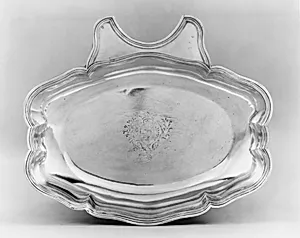
Basin with shaving attachment
1745–46 and 1760–61
Medium
Silver
Dimensions
Overall: 2 1/2 × 10 1/2 × 13 in. (6.4 × 26.7 × 33 cm)
Classification
Metalwork-Silver
Culture
French, Paris
Department
European Sculpture and Decorative Arts
Museum
Metropolitan Museum of Art, New York, NY
Credit
Bequest of Catherine D. Wentworth, 1948
Accession Number
48.187.165a, b
Rights
Public Domain
Art Historical Context
This exquisite silver basin with shaving attachment, crafted by Parisian silversmiths Jean Fauche (1745–46) and Joseph-Pierre-Jacques Duguay (1760–61), exemplifies the opulence of mid-18th-century decorative arts. Housed in the Metropolitan Museum of Art's European Sculpture and Decorative Arts department, this 2½ × 10½ × 13-inch piece was a luxury toiletry item for the elite, blending functionality with lavish craftsmanship. The dual dating reflects collaborative production, likely with Fauche creating the basin and Duguay adding the innovative shaving tray—a hinged attachment for razors and soaps—highlighting the era's meticulous silversmithing guilds in Paris. During Louis XV's reign, French silverwork flourished in the Rococo style, known for its elegant curves, intricate chasing, and polished surfaces that caught the light in grand châteaux. Paris makers like these held prestigious marks of quality, making such objects status symbols among nobility and wealthy bourgeoisie. The basin's design catered to refined grooming rituals, underscoring hygiene's rising cultural importance amid Enlightenment ideals. Bequeathed to the Met in 1948 by Catherine D. Wentworth, this rare survivor offers a glimpse into aristocratic daily life, where beauty elevated even the mundane act of shaving. Its enduring gleam invites visitors to appreciate the technical mastery and cultural splendor of ancien régime France.