
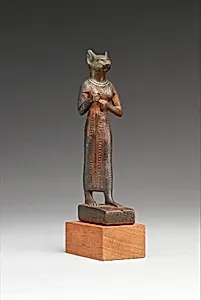
Bastet
Unknown Artist
664–30 B.C.
Medium
Leaded bronze, precious metal and black bronze inlays
Dimensions
H. 10.5 cm (4 1/8 in.); W. 3.2 cm (1 1/4 in.); D. 3.9 cm (1 9/16 in.) H. (with tang): 11.7 cm (4 5/8 in.)
Classification
Figure, Bastet
Period
Late Period–Ptolemaic Period
Department
Egyptian Art
Museum
Metropolitan Museum of Art, New York, NY
Credit
Gift of Florence Blumenthal, 1934
Accession Number
34.6.1
Rights
Public Domain
Tags
Art Historical Context
This elegant bronze statuette of Bastet, created between 664 and 30 B.C. during Egypt’s Late and Ptolemaic Periods, captures the beloved feline goddess who embodied protection, fertility, and domestic harmony. Standing just over four inches tall, the figure would have served as a votive offering placed in temples by devotees seeking the goddess’s favor. Bastet’s dual nature—gentle nurturer and fierce defender—is often conveyed through her cat form, a symbol deeply rooted in Egyptian reverence for felines as guardians against vermin and disease. Crafted from leaded bronze with intricate inlays of precious metal and black bronze, the piece highlights the sophisticated metalworking techniques of the era. Artisans achieved subtle contrasts in color and texture to emphasize details such as jewelry, facial features, and ritual attributes. Such portable bronzes were mass-produced yet individually finished, allowing worshippers from various social strata to participate in temple rituals dedicated to Bastet, whose principal cult center was at Bubastis in the Nile Delta. Today housed in the Metropolitan Museum of Art’s Department of Egyptian Art, this statuette offers a tangible connection to ancient religious life. Its survival underscores the enduring popularity of Bastet’s cult, which continued even as Greek rulers adopted and adapted Egyptian traditions.