
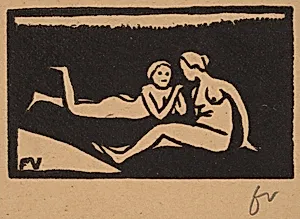
Bathers on the Grass (Baigneuses étendues sur l'herbe)
1893
Medium
woodcut in black on brown wove paper
Dimensions
block: 3.8 x 6.5 cm (1 1/2 x 2 9/16 in.) sheet: 12.6 x 16 cm (4 15/16 x 6 5/16 in.)
Classification
Department
CG-E
Museum
National Gallery of Art, Washington, D.C.
Credit
Ailsa Mellon Bruce Fund
Accession Number
1999.106.3
Rights
Public Domain
Art Historical Context
In 1893, Swiss-born artist Félix Vallotton created *Bathers on the Grass (Baigneuses étendues sur l'herbe)*, a diminutive woodcut printed in black ink on warm brown wove paper. Measuring just 3.8 x 6.5 cm on the block, this intimate print captures a serene scene of reclining female bathers lounging on lush grass, evoking a sense of relaxed intimacy amid nature. Vallotton, who later became a key figure in the Nabis movement alongside artists like Pierre Bonnard and Édouard Vuillard, honed his skills in printmaking during his Paris years, producing over 100 woodcuts in the 1890s. The woodcut medium highlights Vallotton's mastery of bold contrasts and precise line work, influenced by Japanese ukiyo-e prints. By carving away the wood block to leave stark white areas against dense black ink, he achieves a modern graphic intensity on the unconventional brown paper, which infuses the scene with an earthy, sun-dappled glow. This technique not only emphasizes flattened forms and simplified contours—hallmarks of Nabi symbolism—but also nods to contemporary fascination with leisure and the female nude, echoing scandals like Manet's *Déjeuner sur l'herbe*. Housed in the National Gallery of Art through the Ailsa Mellon Bruce Fund, this early work showcases Vallotton's innovative bridge between traditional printmaking and avant-garde aesthetics, making it a gem for visitors exploring fin-de-siècle experimentation in form and light.
About the Artist
Félix Vallotton · 1865–1925
Félix Vallotton (1865–1925) was born in Lausanne, Switzerland, into a comfortable middle-class family, and moved to Paris in 1882 to enroll at the Académie Julian, where he studied under the portrait painter Jules Joseph Lefebvre and the history painter Gustave Boulanger. Paris would remain his home for the rest of his life, and he became a French citizen in 1900 following his marriage to the art ...