
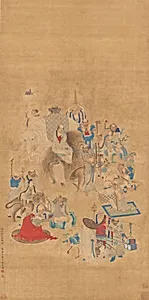
Bathing of the Buddha Festival
Qing dynasty, 1833
Medium
Hanging scroll, ink and color on silk
Dimensions
108.9 × 54.2 cm (42 7/8 × 21 3/8 in.)
Classification
hanging scroll
Department
Arts of Asia
Museum
Art Institute of Chicago
Accession Number
80720
Rights
Public Domain
About this artwork
This affable and remarkably zany cast of characters plays upon the festive atmosphere of an annual celebration held to commemorate the birth of the historical Buddha and his first shower by water-bearing dragons. Some of the disciples pictured flaunt pseudo-religious “miracles”: one opens his stomach to reveal the Buddha nature within and another magically creates a temple in mid-air. Other disciples nonchalantly engage on superficially mundane activities that allude to Buddhist conduct, such as...
Art Historical Context
This hanging scroll by Hua Ziyou captures the vibrant Bathing of the Buddha Festival, a cherished Buddhist ritual celebrating the birth of Siddhartha Gautama. Created in 1833 during the Qing dynasty, the work reflects the continued importance of Buddhist devotional practices in late imperial China, even as Manchu court balanced diverse religious traditions. The festival depicted here involves the ceremonial washing of Buddha images with scented water, symbolizing purification and the washing away of ignorance—a custom that spread widely across East Asia. Painted in ink and color on silk, the scroll format was a traditional Chinese medium prized for its portability and elegance when displayed in temples or scholarly homes. Silk’s smooth surface allowed Hua Ziyou to apply delicate layers of color, bringing life to the festival’s participants and ritual objects. As a work from the Arts of Asia collection at the Art Institute of Chicago, it offers viewers a window into 19th-century Chinese Buddhist culture and the enduring artistic conventions of the hanging scroll.