
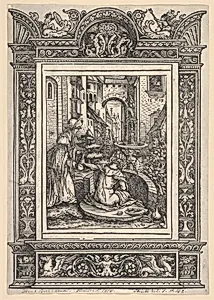
Bathsheba Bathing, from Women's Wile (Weiberlisten)
Medium
Woodcut; second state of three (Hollstein)
Dimensions
Sheet: 8 3/4 × 6 in. (22.3 × 15.2 cm)
Classification
Prints
Department
Drawings and Prints
Museum
Metropolitan Museum of Art, New York, NY
Credit
Gift of Felix M. Warburg, 1920
Accession Number
20.64.23
Rights
Public Domain
Tags
Art Historical Context
### Bathsheba Bathing, from *Women's Wile (Weiberlisten)* This woodcut, *Bathsheba Bathing belongs to the satirical series *Weiberlisten (often translated as "List of" or "Women's Wiles"), a set of early 16th-century German prints that playfully depicted female archetypes drawn from proverbs and folklore. Created collaboratively by Augsburg masters Hans Burgkmairlikely the designer), Hans Weiditz the (renowned for his lively woodcutting), and Jost de Negker (the skilled blockcutter and printer), it represents the pinnacle of Northern Renaissance printmaking. Produced as a woodcut in its second state of three (per Hollstein catalog), the 8 3/4 × 6 in. sheet showcases the era's innovative technique: intricate carving on wood blocks allowed for bold lines, rich tonal contrasts, and affordable mass reproduction, bringing high art to wider audiences. The image portrays the biblical Bathsheba from 2 Samuel 11, bathing unaware as King David spies from afar—a sensual yet morally charged scene symbolizing temptation and vanity. In the *Weiberlisten* context, it fits the series' witty, caricature-like take on women's supposed "wiles," blending eroticism with cautionary humor typical of Reformation-era satire. Weiditz's dynamic style, with expressive poses and detailed textures, captures Bathsheba's graceful form amid flowing water and architecture, highlighting woodcuts' versatility for narrative storytelling. Housed in the Metropolitan Museum of Art's Drawings and Prints department (gift of Felix M. Warburg, 1920), this print exemplifies how Renaissance artists like these pioneers democratized imagery, influencing moral discourse and popular culture across Europe. A delightful window into 16th-century wit and craftsmanship!
About the Artist
Hans Burgkmair|Hans Weiditz the Younger|Jost de Negker · 1473–1531
Hans Burgkmair the Elder (1473–1531) was a German painter and printmaker who became one of the leading artists of the Renaissance in Augsburg. Born into a family of painters — his father, Thoman Burgkmair, was a respected artist — he likely received his initial training in his father's workshop. He may also have studied with Martin Schongauer in Colmar, and a probable visit to Italy around 1507 ex...