
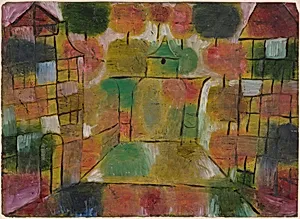
Baum und Architektur--Rhythmen (Tree and Architecture--Rhythms)
1920
Medium
oil on paper
Dimensions
overall: 27.9 x 38.3 cm (11 x 15 1/16 in.)
Classification
Drawing
Department
CG-W
Museum
National Gallery of Art, Washington, D.C.
Credit
Gift of Benjamin and Lillian Hertzberg
Accession Number
2004.140.41.a
Rights
Public Domain
Art Historical Context
Paul Klee's *Baum und ArchitekturRhythmen* (Tree and Architecture--Rhythms), created in 1920, the artist's signature fusion of organic and geometric forms in a compact oil on paper, measuring just 27.9 x 38.3 cm. Though classified as a drawing, this intimate work showcases Klee's painterly technique, applying thin veils of color to evoke rhythmic patterns where a stylized tree intertwines with angular architectural motifs. The modest scale invites close contemplation, much like a personal sketchbook page elevated to poetic abstraction. Painted at the dawn of the Bauhaus era—where Klee began teaching in 1920—this piece reflects the interwar modernist spirit, blending Expressionism's emotional depth with Cubist fragmentation and emerging Constructivist rhythms. Klee, a Swiss-born master of line and color, often drew inspiration from nature's fluidity against human-made structure, symbolizing harmony amid post-World War I upheaval. His innovative use of oil on paper allowed for luminous transparency, a technique that influenced generations of abstract artists. Housed in the National Gallery of Art as a gift from Benjamin and Lillian Hertzberg (Department CG-W), this work exemplifies Klee's playful yet profound exploration of visual music, reminding us how rhythm unites the natural and built worlds in enduring elegance.
About the Artist
Paul Klee · 1879–1940
Paul Klee (1879–1940) was born in Münchenbuchsee, near Bern, Switzerland, into a family of musicians; his father was a German music teacher and his mother a trained singer. The musical environment of his childhood left permanent traces on his art, informing his lifelong interest in rhythm, counterpoint, and structural variation. He studied painting in Munich from 1898, absorbing the currents of la...