
Beach Scene, England
Classification
seascapes
Department
Smithsonian Collection
Museum
Smithsonian American Art Museum
Credit
Gift of Charles Savage Homer, Jr.
Accession Number
1912-12-216
Rights
Public Domain
About this artwork
Research in Progress
Art Historical Context
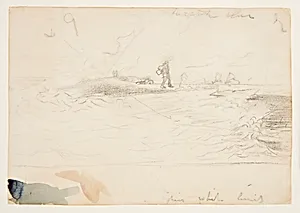
Winslow Homer, a leading American Realist painter (18361910), created *Beach Scene, England* his pivotal 1881–82 sojourn in Tynemouth, on England's North Sea coast. Fresh from acclaim in the United States, Homer sought fresh inspiration abroad, immersing himself in the rugged coastal environment. This seascape captures the raw power of the sea and human interaction with nature, a recurring theme in his oeuvre that elevated everyday scenes to profound statements on isolation and resilience. Homer's Realism shines through in his masterful depiction of light, waves, and figures against the horizon, techniques honed from his earlier watercolor experiments and wood engraving background. Though the medium remains unidentified amid ongoing research, the work exemplifies his shift toward monumental marine subjects, influenced subtly by English artists like the Pre-Raphaelites. Painted at a time when industrialization was transforming coastlines, it evokes a nostalgic purity, blending American vigor with European introspection. Now in the Smithsonian American Art Museum as a gift from Homer's brother, Charles Savage Homer, Jr., this piece invites visitors to ponder the timeless allure of the shore. Its classification as a seascape underscores Homer's enduring legacy in celebrating nature's drama.