
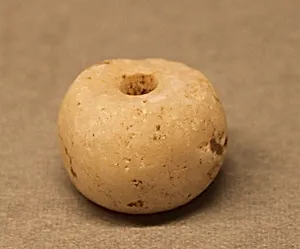
Bead
Unknown Artist
8th–13th century
Medium
Stone
Dimensions
Ht. 5/8 in. (1.6 cm) Diam. 3/4 in. (1.9 cm)
Classification
Stone
Department
Islamic Art
Museum
Metropolitan Museum of Art, New York, NY
Credit
Rogers Fund, 1948
Accession Number
48.101.188
Rights
Public Domain
Art Historical Context
Nestled in the Metropolitan Museum of Art's Islamic collection, this unassuming stone bead exemplifies the everyday artistry of the Islamic world from the 8th to 13th centuries. Carved from durable stone and measuring just 5/8 inch high and 3/4 inch in diameter, its compact form was designed for practical adornment—likely strung into necklaces, bracelets, or belts. Acquired through the Rogers Fund in 194, it invites us to appreciate the subtle craftsmanship of objects that touched daily life. Spanning the Abbasid Caliphate and subsequent regional dynasties, this period saw flourishing trade networks like the Silk Road, where beads served as currency, talismans, and symbols of status. Stone, a resilient medium, was favored for its longevity and availability, often sourced from quarries across the Middle East and North Africa. Artisans expertly drilled the central hole for threading, showcasing precision techniques honed over generations. Though small, this bead reveals the democratic beauty of Islamic decorative arts: not reserved for palaces, but woven into personal expression. It reminds visitors that history's grandeur often hides in humble forms, connecting us to the skilled hands of anonymous makers who bridged cultures through simple elegance.