
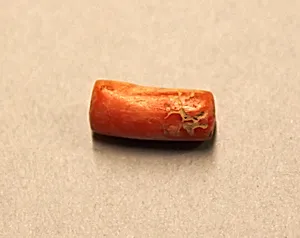
Bead
Unknown Artist
probably 8th–12th century
Medium
Stone (?)
Dimensions
L. 1/2 in. (1.2 m) Diam. 3/16 in. (0.4 cm)
Classification
Stone
Department
Islamic Art
Museum
Metropolitan Museum of Art, New York, NY
Credit
Rogers Fund, 1948
Accession Number
48.101.77b
Rights
Public Domain
Art Historical Context
This unassuming stone bead, likely crafted between the 8th and 12th centuries, offers a glimpse into the everyday artistry of the medieval Islamic world. Measuring a mere 1/2 inch (1.3 cm) in length and 3/16 inch (0.4 cm) in diameter, it exemplifies the precision of ancient stoneworking techniques. Artisans would have carefully drilled a central hole through the hard material—possibly limestone, quartz, or another local stone—for stringing into necklaces, bracelets, or decorative trims, highlighting the skill required for such miniature forms. Housed in the Metropolitan Museum of Art's Islamic Art Department and acquired through the Rogers Fund in 1948, this bead reflects the vibrant trade and craftsmanship across the Abbasid Caliphate and early medieval Islamic regions, from the Middle East to North Africa and beyond. Beads like this were ubiquitous in personal adornment, amulets, and even horse harnesses, serving both practical and talismanic purposes in a culture rich with geometric patterns and symbolic motifs. Though small, its presence in a world-class collection underscores how humble objects illuminate daily life, economic exchange, and cultural continuity. Visitors are invited to imagine it swaying on a merchant's belt or a noble's garment, a tiny testament to enduring human creativity.