
Bead
Early Western Zhou dynasty (1047BC-772BC)
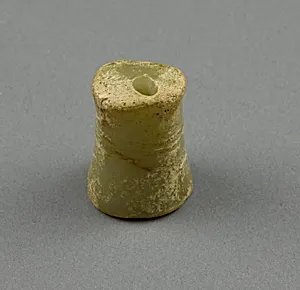
Medium
Jade
Dimensions
3.7 × 2.9 cm (1 7/16 × 1 1/8 in.); 3.7 × 2.9 cm (1 7/16 × 1 1/8 in.)
Classification
jade
Department
Arts of Asia
Museum
Art Institute of Chicago
Accession Number
69088
Rights
Public Domain
Art Historical Context
This delicate jade bead, dating to the Early Western Zhou dynasty (104–771 BCE), offers a glimpse into one of ancient China's most formative eras. Crafted during the Zhou rulers' consolidation of power after overthrowing the Shang, this small ornament—measuring just 3.7 × 2.9 cm—exemplifies the era's reverence for jade, a stone symbolizing purity, immortality, and moral virtue. Zhou society, with its emphasis on ritual propriety and the "Mandate of Heaven," jade artifacts as markers of elite status, often adorning belts, pendants, or ceremonial suits. Jade carving techniques were highly advanced by this time, involving precise drilling for suspension and meticulous polishing to achieve a luminous, translucent glow. Nephrite jade, prized for its toughness and creamy white to green hues, was laboriously worked by hand using abrasives like sand and bamboo. Though simple in form, this bead's survival speaks to the enduring cultural importance of such objects in burials and daily adornment, bridging the mundane and the sacred. Today, housed in the Art Institute of Chicago's Arts of Asia department, it invites us to ponder the artistry of unnamed craftsmen whose skill shaped China's jade tradition for millennia.
About the Artist
Unknown
The artist designated as "Unknown" in our virtual museum's collection exemplifies a poignant chapter in art history: creators whose identities have faded into obscurity despite the enduring power of their work. With only one known artwork attributed to them in our holdings, this figure represents countless anonymous hands that shaped visual culture across centuries. Museums worldwide, including th...