
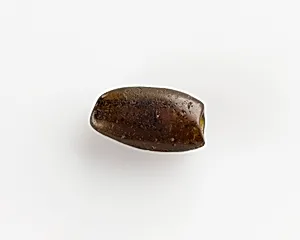
Bead
4th-6th century
Classification
Jewelry and Ornament
Department
Smithsonian Collection
Museum
Smithsonian American Art Museum
Credit
Gift of Charles Lang Freer
Accession Number
F1909.1055
Rights
Public Domain
Tags
About this artwork
To 1909
Art Historical Context
This delicate glass bead, dating to the 4th-6th century, hails from the Ancient Near East—a region encompassing modern-day Iraq, Syria, and Iran—where such ornaments were everyday treasures. Crafted during late antiquity, a time of cultural exchange along Silk Road trade routes, it exemplifies the era's jewelry and personal adornments. Though small, beads like this were strung into necklaces, bracelets, or sewn onto garments, serving as symbols of status, protection, or simply beauty in daily life. Glassmaking in the Near East reached impressive sophistication by this period, with artisans likely using techniques like core-forming or molding molten glass around a metal rod, then decorating with trails of contrasting colors. While the exact form and hues of this bead remain understated in records, its survival speaks to the durability of these ancient crafts, traded far and wide. Acquired by collector Charles Lang Freer by 1909 and gifted to the Smithsonian, this piece now resides in the Smithsonian American Art Museum's collection. It offers visitors a tangible link to forgotten lives, reminding us how even humble objects illuminate the artistry of early civilizations.
About the Artist
Unknown
The artist designated as "Unknown" in our virtual museum's collection exemplifies a poignant chapter in art history: creators whose identities have faded into obscurity despite the enduring power of their work. With only one known artwork attributed to them in our holdings, this figure represents countless anonymous hands that shaped visual culture across centuries. Museums worldwide, including th...