
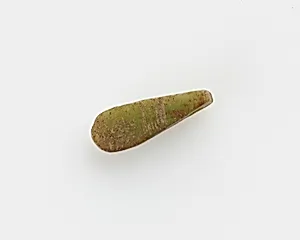
Bead, wedge-shaped
1550-1196 BCE
Classification
Jewelry and Ornament
Department
Smithsonian Collection
Museum
Smithsonian American Art Museum
Credit
Gift of Charles Lang Freer
Accession Number
F1909.1490
Rights
Public Domain
Tags
About this artwork
To 1909
Art Historical Context
This delicate wedge-shaped bead hails from ancient Egypt's New Kingdom period (ca. 1550–1196 BCE), a golden age of imperial power, monumental architecture, and refined craftsmanship. Crafted from vibrant glass—a material the Egyptians helped pioneer around 1500 BCE—this small ornament exemplifies everyday luxury in a civilization renowned for its jewelry. Though tiny, its precise wedge form suggests it was strung into necklaces, amulets, or belts, adorning both elites and commoners during rituals, daily wear, or as trade goods. Glass beads like this one highlight innovative techniques: artisans melted silica sand with natron flux in crucibles, then shaped molten glass by trailing or molding. Colored with metallic oxides for striking blues, greens, or earth tones (inferred from surviving examples), they symbolized prosperity, protection, and the divine sparkle of lapis lazuli substitutes. In the New Kingdom, such beads proliferated via expanded trade networks, reflecting Egypt's cultural and economic dominance. A gift from collector Charles Lang Freer to the Smithsonian by 1909, this piece from the Freer collection invites us to ponder the lives of its ancient makers—anonymous yet masterful. At the Smithsonian American Art Museum, it bridges millennia, whispering of enduring human creativity.
About the Artist
Unknown
The artist designated as "Unknown" in our virtual museum's collection exemplifies a poignant chapter in art history: creators whose identities have faded into obscurity despite the enduring power of their work. With only one known artwork attributed to them in our holdings, this figure represents countless anonymous hands that shaped visual culture across centuries. Museums worldwide, including th...