
Beaded Necklace
Unknown Artist
500–600
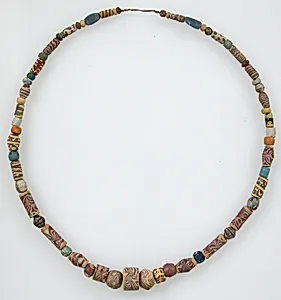
Medium
Glass
Dimensions
Overall: length of string 29 15/16 x 13/16 in. (76.1 x 2 cm)
Classification
Glass-Beads
Culture
Frankish
Department
Medieval Art
Museum
Metropolitan Museum of Art, New York, NY
Credit
Gift of J. Pierpont Morgan, 1917
Accession Number
17.193.134
Rights
Public Domain
Tags
Art Historical Context
This exquisite Beaded Necklace crafted by an unknown Frankish artist around 500–600 CE, offers a glimpse into early medieval during the Merovingian period. The Franks, a Germanic people who rose to prominence in what is now France and Germany after the fall of the Roman Empire, such jewelry as status symbols and trade goods. Donated to the Metropolitan Museum of Art 1917 by J. Pierpont Morgan, this now resides in the Medieval Art department, highlighting the continuity of craftsmanship from antiquity into the Middle Ages. Made entirely of glass beads strung to a length of nearly 30 inches (76 cm), the necklace showcases the sophisticated glassworking techniques of the era. Frankish artisans drew on Roman traditions, likely using methods like drawn or wound glass to create small, colorful beads that caught the light. These were not mere decorations; necklaces like this held cultural importance, worn by women in daily life, rituals, or as grave goods, reflecting social standing and connections to wider trade networks across Europe. Though simple in form, its preservation speaks volumes about the durability of glass and the value placed on personal adornment. Visitors can imagine it adorning a Frankish noble, bridging the worlds of pagan traditions and emerging Christian influences in early medieval Europe.