
Necklace
Unknown Artist
5th–7th century
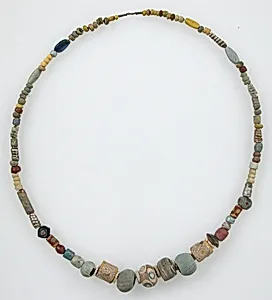
Medium
Glass, shell, glazed earthenware (faience)
Dimensions
Overall: length of string 28 1/8 x 11/16 in. (71.5 x 1.8 cm)
Classification
Glass-Beads
Culture
Frankish
Department
Medieval Art
Museum
Metropolitan Museum of Art, New York, NY
Credit
Gift of J. Pierpont Morgan, 1917
Accession Number
17.193.94
Rights
Public Domain
Art Historical Context
This exquisite Frankish necklace, dating to the 5th–7th century, offers a glimpse into the daily adornments of early medieval Europe during the Merovingian period. Crafted by an unknown artisan, it reflects the vibrant material culture of the Franks, a Germanic people who established kingdoms across what is now France and Germany after the fall of Rome. Such necklaces were likely worn by women as personal jewelry, possibly signifying status, identity, or protection in a time of cultural transition. The necklace's beads—made from colorful glass, polished shell, and glazed earthenware (faience)—demonstrate sophisticated craftsmanship and access to diverse materials. Glass beads, often translucent and vibrant, were produced using techniques like trailing or molding molten glass, while faience, with its glossy blue-green glaze, evoked ancient Egyptian traditions adapted in Europe. Shell added a natural, organic texture. Stretched to about 28 inches, it would have draped elegantly around the neck, highlighting the Franks' skill in beadwork and trade networks spanning the Mediterranean. Now housed in the Metropolitan Museum of Art's Medieval Art Department, this piece was generously gifted by J. Pierpont Morgan in 1917. It stands as a tangible link to Frankish life, inviting us to imagine the hands that strung it centuries ago.