
Beads
Unknown Artist
3rd–12th century
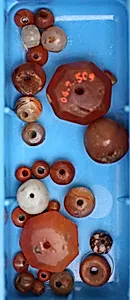
Medium
Agate, one porphyry
Dimensions
5 7/8 in. (14.9 cm)
Classification
Jewelry
Department
Islamic Art
Museum
Metropolitan Museum of Art, New York, NY
Credit
Gift of Darius Ogden Mills, 1904
Accession Number
04.2.509a–aa
Rights
Public Domain
Art Historical Context
Nestled in the Metropolitan Museum of Art's Art collection, *Beads* is a delicate strand of jewelry dating from the 3rd to 12th century. Crafted from agate—a durable, translucent semi-precious stone prized for its banded patterns—and featuring one distinctive porphyry bead, this piece measures just 5 7/8 inches (14.9 cm) long. Such materials were abundant in the Islamic world, from regions like Egypt, India, and the Arabian Peninsula, and valued for their beauty and symbolic properties, often believed to offer protection or enhance status. In the expansive era spanning early Islamic caliphates to the medieval period, beads like these adorned necklaces, bracelets, and talismans, reflecting vibrant trade networks along the Silk Road and Indian Ocean routes. Artisans expertly drilled and polished the stones, showcasing technical skill in creating smooth, uniform spheres that caught the light. This anonymous work highlights everyday artistry in Islamic culture, where jewelry blended utility, spirituality, and luxury. Generously gifted to the Met in 1904 by Darius Ogden Mills, *Beads* invites us to imagine the hands that strung it—perhaps a merchant's wife or a noble child—bridging ancient lives to our modern gaze. A testament to enduring craftsmanship, it whispers stories of a interconnected world long past.