
Beads
Unknown Artist
3rd–12th century
Medium
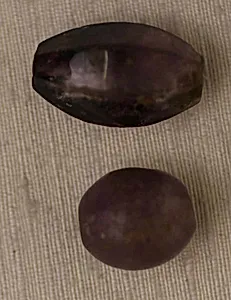
Amethyst; faceted
Dimensions
A: H. 7/8 in. (2.2 cm) Diam. 9/16 in. (1.4 cm) Wt. 0.18 oz. (5.1 g) B: H. 5/8 in. (1.6 cm) Diam. 9/16 in. (1.4 cm) Wt. 0.14 oz. (4 g)
Classification
Jewelry
Department
Islamic Art
Museum
Metropolitan Museum of Art, New York, NY
Credit
Gift of Helen Miller Gould, 1910
Accession Number
10.130.3424a, b
Rights
Public Domain
Art Historical Context
Nestled in the Metropolitan Museum of Art's Islamic Art collection, these delicate amethyst beads, gifted by Helen Miller Gould in 191, hail from the vast span of the 3rd to 12th centuries. Crafted an unknown artist, the pair showcases two faceted gems: one measuring 7/8 inch high with a 9/16-inch diameter (weighing 0.18 oz.), and the other slightly smaller at 5/8 inch high (0.14 oz.). Their violet hue and precise facets highlight the lapidary expertise of ancient artisans, who transformed raw amethyst—a quartz prized for its clarity and color—into luminous jewelry components. In the Islamic world, beads like these were integral to personal adornment, strung into necklaces, bracelets, or amulets. Faceting, a sophisticated technique involving cutting flat surfaces to maximize light reflection, reflects advanced stoneworking traditions that flourished along trade routes from Persia to North Africa. Amethyst held cultural allure, often symbolizing protection and purity across ancient Mediterranean and Islamic societies. Though modest in size, these beads offer a window into everyday elegance and craftsmanship during a golden age of Islamic material culture, where gemstones bridged utility and artistry. Visitors can appreciate how such treasures connected wearers to broader networks of exchange and beauty.