
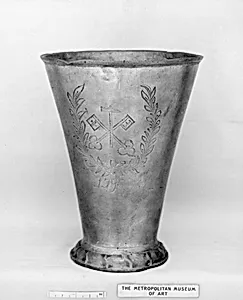
Beaker
probably ca. 1790
Medium
Pewter
Dimensions
Overall: 7 3/4 × 5 7/8 in. (19.7 × 14.9 cm)
Classification
Metalwork-Pewter
Culture
Swedish, Stockholm
Department
European Sculpture and Decorative Arts
Museum
Metropolitan Museum of Art, New York, NY
Credit
Rogers Fund, 1906
Accession Number
06.749
Rights
Public Domain
Art Historical Context
This elegant pewter beaker, crafted by Stockholm pewterer Carl Gustaf Malmborg around 1790, exemplifies the refined metalwork of late 18th-century Sweden. at 7 3/4 inches tall and 5 7/8 inches wide, it was designed as a practical yet sophisticated drinking vessel, reflecting the everyday luxury of Scandinavian households during the Enlightenment era. Pewter, an alloy primarily of tin with traces of lead and other metals, was prized for its malleability, lustrous finish, and affordability compared to silver. Swedish artisans like Malmborg, working in Stockholm's vibrant workshops, elevated the medium through skilled hammering, chasing, and polishing techniques, often regulated by strict guilds to ensure quality. This beaker hails from a time when neoclassical influences brought clean lines and subtle elegance to decorative arts. Acquired through the Rogers Fund in 1906, it now graces the Metropolitan Museum of Art's European Sculpture and Decorative Arts collection. Visitors can appreciate how such objects bridged utility and artistry, offering a tangible glimpse into Swedish cultural life.