
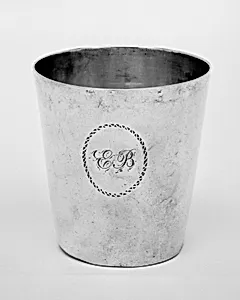
Beaker
late 18th century
Medium
Silver
Classification
Metalwork-Silver
Culture
British, provincial or Irish
Department
European Sculpture and Decorative Arts
Museum
Metropolitan Museum of Art, New York, NY
Credit
Bequest of Alphonso T. Clearwater, 1933
Accession Number
33.120.65
Rights
Public Domain
Art Historical Context
This elegant silver beaker, crafted by the silversmith L.A. in the late 18th century, hails from provincial Britain or Ireland, reflecting the refined metalworking traditions of the Georgian era. Beakers like this were prized drinking vessels, often used inerns, homes, or settings by the emerging middle class. Its provincial or Irish origin suggests a piece made outside major centers like London, where local artisans adapted high-end London styles with more accessible techniques and motifs, making luxury silver attainable beyond the elite. The medium of silver underscores its dual role as functional art and status symbol. Silversmiths employed hallmarks—stamped marks denoting purity, maker, and origin—to guarantee quality, a practice central to British and Irish metalwork. L.A.'s work exemplifies the era's chase-and-relief techniques, where intricate patterns were hammered into the surface for texture and shine, blending utility with subtle ornamentation. Bequeathed to the Metropolitan Museum of Art by Alphonso T. Clearwater in 1933, this beaker now graces the European Sculpture and Decorative Arts department. It offers a window into 18th-century craftsmanship, reminding us how everyday objects carried cultural prestige. (198 words)