
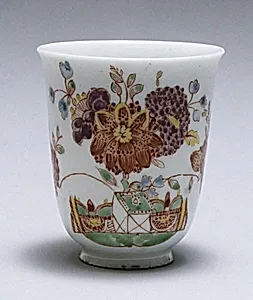
Beaker
ca. 1765
Medium
Hard-paste porcelain
Dimensions
Height: 3 in. (7.6 cm)
Classification
Ceramics-Porcelain
Culture
Italian, Florence
Department
European Sculpture and Decorative Arts
Museum
Metropolitan Museum of Art, New York, NY
Credit
The Hans Syz Collection, Gift of Stephan B. Syz and John D. Syz, 1995
Accession Number
1995.268.148
Rights
Public Domain
Tags
Art Historical Context
This exquisite beaker, produced by the Doccia Porcelain Manufactory in around 1765, captures the refined elegance of 18th-century ceramics. Standing just 3 inches (7.6 cm) tall, it is crafted from hard-paste porcelain durable, translucent material made by firing kaolin clay at high temperatures. This technique, pioneered in Europe to rival prized Chinese imports, allowed Doccia artisans to create finely detailed objects prized by the aristocracy. Founded in 1735 near Florence, the Doccia manufactory was Italy's foremost center for hard-paste porcelain blending technical innovation with decorative flair. Adorned with delicate floral motifs—a hallmark of Rococo-inspired designs—this beaker reflects the era's love for nature's abundance and ornate beauty. Such small-scale vessels were often used for liqueurs or as table ornaments, showcasing the factory's mastery in miniature forms. Now part of The Hans Syz Collection at The Metropolitan Museum of Art, this piece highlights Doccia's role in Europe's porcelain revolution, bridging artistry and industry during a time of cultural splendor. Visitors will appreciate its subtle glow and intricate blooms, a testament to enduring Tuscan craftsmanship.
About the Artist
Doccia Porcelain Manufactory · 1737–1896
The Doccia Porcelain Manufactory, founded in 1737 by Marquis Carlo Ginori near Florence, holds the distinction of being Italy's first hard-paste porcelain manufacturer and one of the few European porcelain enterprises to survive from the eighteenth century to the present day without interruption. Unlike most contemporary ventures — which depended on the patronage and protection of ruling courts — ...