
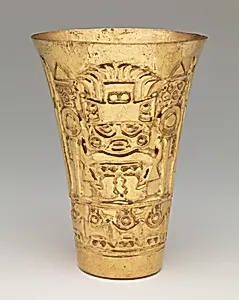
Beaker
10th–11th century
Medium
Gold
Dimensions
H. 6 × W. 4 1/4 × D. 4 in. (15.2 × 10.8 × 10.2 cm)
Classification
Metal-Containers
Culture
Lambayeque (Sicán)
Department
Arts of Africa, Oceania, and the Americas
Museum
Metropolitan Museum of Art, New York, NY
Credit
Jan Mitchell and Sons Collection, Gift of Jan Mitchell, 1991
Accession Number
1991.419.63
Rights
Public Domain
Art Historical Context
This exquisite gold beaker, crafted by Lambayeque (Sic) artists in Peru's northern coast during the 10th11th century, exemplifies pinnacle of pre-Columb metallurgy. The Sicán culture, flourishing after the decline of the Moche, was renowned for its mastery of goldworking, transforming the precious metal into symbols of elite status and spiritual power. Measuring just 6 inches tall, this vessel's elegant, slightly flared form suggests it served as a ceremonial drinking cup, likely used in rituals honoring deities or ancestors. Gold held profound cultural significance for the Sicán, representing the sun's divine essence and the life-giving forces of the cosmos. Artisans employed advanced techniques like hammering, repoussé, and depletion gilding to achieve the metal's radiant luster, showcasing their technical virtuosity without modern tools. Such beakers often accompanied high-ranking lords in elaborate burials, underscoring the object's role in funerary practices and social hierarchy. Housed in the Metropolitan Museum of Art's Arts of Africa, Oceania, and the Americas department, this beaker from the Jan Mitchell Collection invites us to marvel at the Sicán's enduring legacy of innovation and artistry, bridging ancient Andean traditions with our modern appreciation for their splendor.