
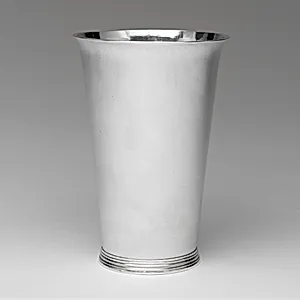
Beaker
1730–70
Medium
Silver
Dimensions
Overall: H. 7 in. (17.8 cm); 13 oz. 5 dwt. (412 g) Lip: Diam. 4 3/4 in. (12.1 cm) Base: Diam. 3 3/16 in. (8.1 cm)
Classification
Beaker
Culture
American
Department
The American Wing
Museum
Metropolitan Museum of Art, New York, NY
Credit
Bequest of Alphonso T. Clearwater, 1933
Accession Number
33.120.104
Rights
Public Domain
Art Historical Context
This elegant silver beaker, crafted by York silversmith Adriancker between 1730 and 1770, exemplifies the refined artistry of colonial America. Standing 7 inches tall with a flared lip diameter of 4¾ inches and a sturdy base of 3⅛ inches, it weighs a substantial 13 ounces and 5 dwts, underscoring the material's prestige and durability. Bancker, part of a prominent Dutch-American family of silversmiths in Manhattan, produced functional yet luxurious objects for affluent households. In the 18th century, silver beakers like this were essential for serving wine, ale, or punch in homes, taverns, and social gatherings, symbolizing wealth and status amid growing colonial prosperity. The medium—pure silver, likely hand-hammered and seamed—highlights advanced metalworking techniques imported from Europe but adapted locally, blending British Georgian influences with American practicality. Such pieces were heirlooms, passed down generations, reflecting the era's transatlantic trade and craftsmanship. Housed in The Metropolitan Museum of Art's American Wing through the 1933 bequest of Alphonso T. Clearwater, this beaker offers a tangible link to everyday life in pre-Revolutionary New York, inviting us to toast the ingenuity of early American makers.