
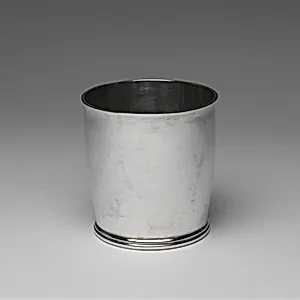
Beaker
ca. 1776–96
Medium
Silver
Dimensions
Overall: H. 3 3/16 in. (8.1 cm); 3 oz. 9 dwt. (107.7 g) Lip: Diam. 3 1/8 in. (7.9 cm) Base: Diam. 2 3/4 in. (7 cm)
Classification
Beaker
Culture
American
Department
The American Wing
Museum
Metropolitan Museum of Art, New York, NY
Credit
Bequest of Alphonso T. Clearwater, 1933
Accession Number
33.120.108
Rights
Public Domain
Art Historical Context
This elegant silver beaker, crafted by New York silversmith Cary around 1776–96, exemplifies the refined craftsmanship of early American decorative arts. Standing just over 3 inches tall with a weight of about 3.5 ounces, its simple cylindrical form—flaring slightly at the lip and resting on a molded base—s the practical yet sophisticated designs favored in post-Revolutionary America. Dunn, active in Manhattan during this formative period, produced hollowware for affluent households and taverns, blending British influences with emerging American tastes. Silver beakers like this one served as drinking vessels for beverages such as punch or ale, symbolizing hospitality and status in a young republic. The medium's durability and luster made silver a prized choice for heirloom pieces, often passed down through generations. Hand-hammered and seamed from sheet silver, such objects highlight the silversmith's skill in achieving balance and proportion without ornate embellishment, aligning with the neoclassical restraint of the Federal style. Now housed in The Metropolitan Museum of Art's American Wing through the bequest of Alphonso T. Clearwater in 1933, this beaker offers a tangible link to everyday life in late 18th-century New York, inviting us to appreciate the quiet artistry of America's silversmithing tradition.